Financial Inclusion
- Home
- Financial Inclusion
Financial Inclusion
BFL firmly believes that financial inclusion i.e. delivery of financial services at affordable costs to the sections of disadvantaged and low-income segments of the society and linking the poor to mainstream financial services, is the key to empowerment. BFL through the SHG movement creates savings habit and internal rotation of funds among its members. The members are also linked to mainstream banking. BFL also facilitates credit linkage through on lending from banks, and other Financial Institutions for income generation and livelihood activities.
BFL’s financial inclusion initiative had its humble start in the parent NGO, Bullock-cart Workers Development Association (BWDA) as the BWDA Microfinance Programme on 09.09.1999 with the first loan assistance from RMK, New Delhi. BWDA received loans for on lending from the Govt., financial institutions and banks like RMK, SIDBI, VGB, SBT, IOB, FWWB, HDFC, Dhanalakshmi Bank, CORDAID, RABO Bank Foundation, etc. for the microfinance programme. In 2003, BWDA acquired an NBFC, renamed as BWDA Finance limited (BFL) to streamline financial inclusion operations.
The Microfinance Programme has now matured into a full fledged financial inclusion programme offering a bouquet of market led financial services to low income households. The financial inclusion programme directly and through partnerships offers members savings (through the SHG model), credit linkage, remittance, pension and insurance.
BFL has adopted industry benchmarked process and systems to ensure a robust operations. At present BFL offers its services, primarily through Self Help Groups (SHGs). A SHG is small, economically homogeneous and affinity group of rural/urban poor, voluntarily formed to save and contribute to a common fund to be lent to its members as per the groups’ decision and for working together for social and economic upliftment of their families and community. BFL offers a range of customer oriented products and services to cater to member needs.
BFL is a member of Sadhan, SRO, and adopts all guidelines given by RBI to ensure client protection. BFL has partnered with Credit Bureaus to curb multiple lending. BFL is client-centric and works for the holistic development of members through various development initiatives and credit plus services.
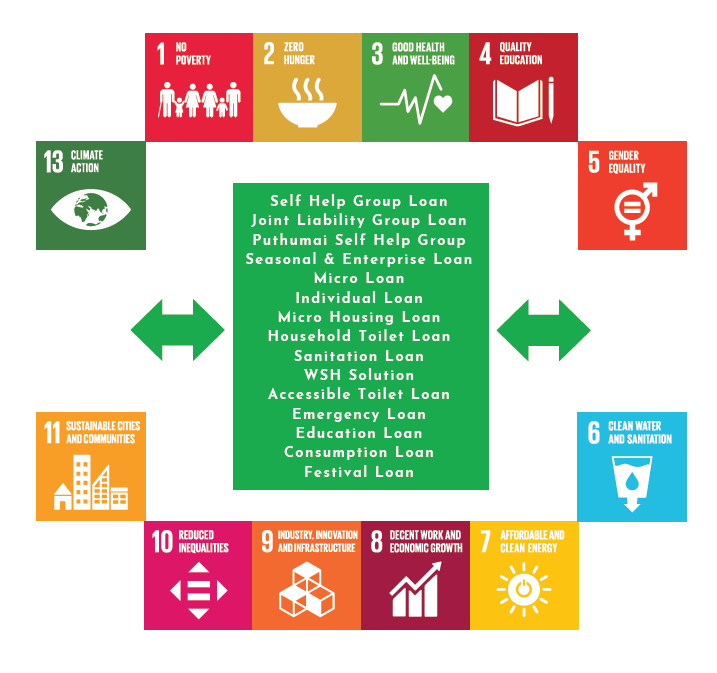
Financial inclusion provides an important tool to build resilience and realise the shared prosperity envisioned by the SDGs. Financial inclusion (access to financial services) is positioned as an enabler of 13 Sustainable developmental goals. It is also featured as a target in eight of the seventeen goals.
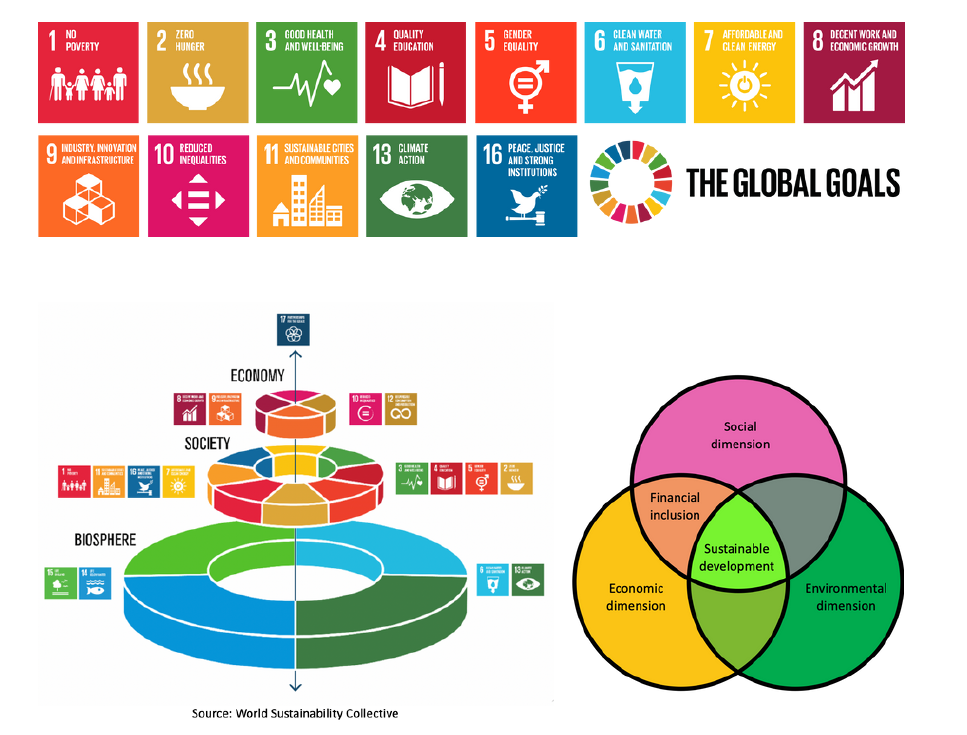
Financial inclusion meets sustainable development at the intersection of the economic and social
dimensions of sustainable development. Research shows that financial inclusion has measurable impact on overall economic growth,
the achievement of broader development goals and,
- Promotes economic growth and financial stability
- Poverty reduction
- Reduction in income inequality
- Mitigating financial risk
- Builds resilience in time of crisis
- Improving earning potential
- Enhanced women empowerment
- Stable financial systems and economies
BFL firmly believes that financial inclusion i.e. delivery of financial services at affordable costs to disadvantaged and low-income segments of society and linking of the poor to mainstream financial services in a sustainable and responsible way is the key to empowerment. BFL through the SHG movement creates savings habit and internal rotation of funds among its members. BFL facilitates credit linkage through on lending from banks, and other Financial
Institutions, Business Correspondent partnerships for income generation and livelihood activities.
BFL believes in the holistic development of beneficiaries and implements projects that contribute to 14 Sustainable Development Goals.
- Promoting gender equality (BWDA Pudhumai Groups)
- Water and Sanitation for All (BWASH – BWDA Water, Sanitation and Hygiene Program)
- Eliminating extreme poverty and promoting shared economic growth
- Climate Crisis Response and access to green energy (BWDA Rehabilitation Program)
- Advancing Financial Inclusion to Improve Access to Education and Health Facilities